
Playa Guiones Wave Mechanics. The Science Behind It
Playa Guiones is the heart of Nosara, often described by surfers as a "wave machine." Unlike the heavy, bone-breaking barrels of beach breaks in other regions, Guiones offers a uniquely forgiving, long-rolling ride that can extend for over 200 yards.
This "user-friendly" reputation isn't just luck or marketing; it’s the result of an intersection of underwater topography, seasonal swell windows, and predictable atmospheric patterns. To truly understand why Guiones breaks the way it does, we have to look deeper into the mechanics of this beach.

1. The "Soft Angle": Why Guiones Breaks Gently
The most defining characteristic of Playa Guiones is its bathymetry (the topography of the ocean floor). Some of the world-class beach breaks have a steep drop-off where deep water hits a shallow sandbar abruptly, causing the wave energy to "dump" all at once.
Guiones features a remarkably soft angle and gradual gradient. As long-period groundswells approach the shore, they begin to "feel" the bottom much further out than at other beaches. Because the depth decreases so slowly, the speed at which the wave breaks decreases gradually. This allows the wave to shed its energy slowly, standing up into a peeling, crumbling wall rather than a collapsing curtain of water.
2. The Sand Bottom: Consistency Without the Chaos
Many renowned surfing spots rely on jagged reef or rock outcroppings to shape the wave, Guiones is almost entirely a sand-bottom break.
The absence of rocks means there are no fixed obstacles to create "boils" or unpredictable turbulence, at least on the main beach. While sandbars do shift with the seasons and longshore currents, they generally maintain a smooth, uniform surface. This results in a "pure" wave pattern where the energy moves across the sand in an organized fashion, making the take-offs less scary the rides smoother.
3. The Swell Window: A Multi-Season Magnet
Playa Guiones is a "wave magnet" because it is perfectly positioned to receive energy from two distinct sources:
The Southern Hemisphere (April – November): Massive storms in the South Pacific send long-period swells hitting Guiones from the South-Southwest (SSW).
The Northern Hemisphere (December – March): In the dry season, storms in the North Pacific send West-Northwest (WNW) swells.
Because Guiones faces directly into the open Pacific with an unobstructed window, it catches nearly every bit of energy moving through the ocean, ensuring consistent surf year-round.
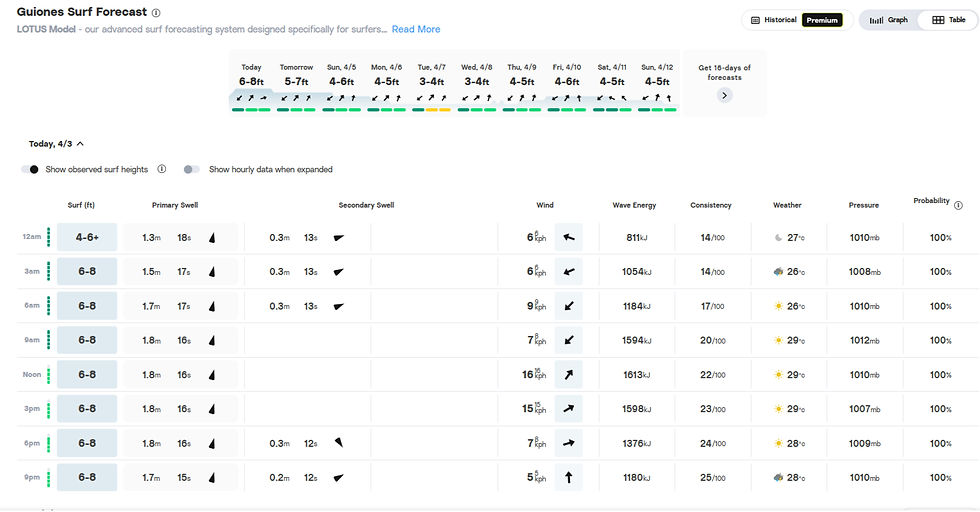
4. Low Tide Surfing
At most beach breaks, a dead-low tide is a recipe for "close-outs" (when the whole wave collapses at once). However, Guiones is very surfable around low tide.
Because the beach is shallow and the angle is so soft, even when the tide is out, the wave doesn't become a "thumper." Instead, it breaks further out on the outer bars, and it only breaks faster than in higher tides. This makes it one of the few places where you can find a quality ride regardless of what the tide chart says.
5. Weather Dynamics
The weather in Nosara follows a remarkably stable rhythm that plays directly into the surf quality:
Sunny Mornings: Even in the heart of the rainy season, mornings are typically clear and sunny. This usually coincides with light offshore winds that "groom" the wave faces into a glassy finish. These offshore winds could remain for the whole day during cold fronts (vientos alisios) that hit the Guancaste coast mostly during dry season.
The Afternoon Rain: During the wet season, rains usually arrive in the afternoon. Most often, these are short-lived bursts lasting a few minutes to a couple of hours.
The Reset: Interestingly, a quick afternoon rain often "cleans up" the conditions by cooling the air and flattening the surface chop, leading to a pristine sunset session.
The Exception: It is worth noting that during heavy tropical storms in the wet season, the wind can turn "onshore," making conditions messier and more "textured" for a few days at a time.
6. Pristine Water Quality
Finally, the mechanics of the wave are complemented by the environment itself. Playa Guiones is known for its clean, non-polluted water. Because the town of Nosara has strict building regulations and a massive protected forest buffer (the Ostional Wildlife Refuge), there is very little industrial or urban runoff. You’re riding waves in high-clarity, "Blue Flag" certified water, which adds a level of comfort to every session.

Conclusion
Whether you are a longboarder looking for a 200-yard "trim" or a shortboarder looking for a high-performance canvas, the unique physics of Playa Guiones make it one of the most reliable and enjoyable waves on the planet. If you're curious about surfing in Playa Guiones, reach out to us at Surf Celeste and we'll be able to provide information or help you plan a trip.


